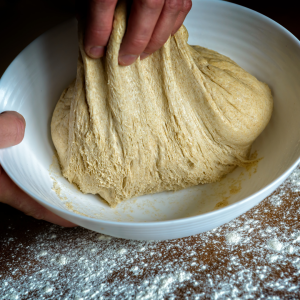
The stretch-and-fold method is fundamental in sourdough baking and essential for developing gluten strength and structure in the dough. This technique involves gently stretching and folding the dough at intervals during fermentation, promoting an even distribution of gases and creating a desirable crumb structure in the final loaf.
Life Lessons & Sourdough
The stretch and fold method has taught me more than I would have ever imagined working with sourdough could teach someone. But also, there’s a lesson in everything. Over two years, I slowly entered the world of sourdough. I started making bread for my family and fell in love with the method. I enjoy the little things that create space for me to take it slow and steady. Cooking from scratch, making espresso, or gardening are other activities that remind me to take it slow and enjoy the process. It brings me peace, and I find harmony in the methods. Honestly, it’s when I do my best thinking.
I’ve learned you can’t hurry baking, especially with sourdough. It takes precious time, planning, and a just-right environment. As a result, sourdough can be stubborn and must be nurtured daily to survive. For the reasons listed here, I am sourdough! I also need all these things to flourish; I need to be nurtured, and I can sometimes be stubborn (ask my husband). Wink! Wink!
Stretch and Fold Builds Character
My relationship with the bubbly, sour goodness has taught me a lot. For example, procrastination is off the table with sourdough. I have to make the plan and work the plan. But even when I make a plan, I often fail. Thus, I am forced to fall flat gracefully (pun intended, dang, that over-proofing). Falling flat gracefully terrifies me. HOW DO YOU FALL FLAT GRACELFULLY? You fall into the Father’s arms. God is capable, qualified, and competent enough to catch you when you fall. In His kindness, he wants to stretch and fold you. Learning from the hard things builds character, like the stretch and fold method. It constructs the character of the dough, making it stronger and helping it RISE!
The Process Is Crucial
Therefore, I connect to the sourdough process and how each step is crucial to creating bread that will be a desirable loaf in its completion. So, where do you need to allow God to do a little stretch and fold method on you? Do you need to start the project you’ve been putting off, trust Him with that dream buried deep in your heart, or be obedient in having that hard conversation? Whatever that nudge that keeps you up at night and is nagging you to take the first step? I’m learning to listen to that voice of knowing. I realize procrastination is fear. Fear of beginning. Fear of failure. Ask anyone who’s ever been ridden by a deep passion if fear ushered its way in. I’m sure they would tell you fear started knocking when passion entered the story.
You courage by couraging.
Brene Brown
Sourdough isn’t as complex as it seems; it only requires you to start, fail, and start again. SUCH IS LIFE! Therefore, when I fail at the method, I dig deeper to understand the “why.” Likewise, when I fail at the life method, I dig a little deeper to figure out that I must stretch and fold, too!
I am sourdough, and sourdough is me.

The Ingredients:
Ingredients:
- Sourdough starter
- All-Purpose Flour
- Maple Syrup
- Olive Oil
- Water
- Salt
The Method:
Instructions:
- Prepare the Dough:
- Mix your sourdough starter with flour and water to create the initial dough. Allow it to rest for 30 minutes to an hour to autolyze, allowing the flour to fully hydrate.
- First Fold:
- After the autolyze period, add salt, maple syrup, and olive oil and incorporate them evenly. You can use a mixer or your hands. If using your hands, wet them to prevent sticking, then grab one edge of the dough, gently stretch it upwards, and fold it over the center. Repeat this process from all four sides of the dough. Stretch and fold into a square shape like an envelope.
- Rest Period:
- Let the dough rest, covered, for about 20-30 minutes to relax the gluten.
- Second Fold:
- After the rest period, perform another round of stretch and fold. Repeat the same process as the first fold, gently stretching the dough from all four sides and folding it towards the center.
- Subsequent Folds:
- Depending on your recipe and dough hydration, you may perform additional rounds of stretch and fold at intervals of 30 minutes to an hour, typically for 3-5 folds. Each stretch and fold strengthens the gluten network and improves the dough’s structure.
- Bulk Fermentation:
- Once you’ve completed the desired number of stretch and folds, allow the dough to undergo bulk fermentation, during which it will rise and develop flavor. This typically takes several hours and involves periodic stretching, folding, and resting intervals.
- Shaping and Proofing:
- After bulk fermentation, shape the dough into your desired loaf shape and let it proof before baking. The stretch and fold method helps create a stronger, more elastic dough, making it easier to shape and resulting in a better rise during proofing.

Why the Stretch and Fold Method is Important:
- Gluten Development:
- The stretch and fold method strengthens the gluten network, which is essential for capturing the carbon dioxide produced during fermentation. This results in a better rise and a lighter, airier crumb in the finished loaf.
- Even Fermentation:
- The stretch and fold method promotes even fermentation by redistributing yeast and gas bubbles throughout the dough. This helps prevent large air pockets and ensures a consistent texture in the final bread.
- Improved Dough Structure:
- The repeated folding creates layers within the dough, contributing to a more uniform structure and better oven spring. This results in a loaf with a more appealing shape and texture. Making it easier to manipulate when scoring designs.
- Flavor Development:
- Stretching and folding the dough encourages the release of organic acids and other flavor compounds produced during fermentation. This enhances the bread’s overall flavor profile, resulting in a richer, more complex taste.
In summary, the stretch and fold method is crucial in sourdough baking, contributing to gluten development, even fermentation, improved dough structure, and enhanced flavor. By mastering this technique, bakers can achieve consistently excellent results in their sourdough loaves.


Leave a Reply